Answer engine optimization for SaaS: a 2026 playbook
Updated 25 Oct 2026
By Snehil Srivastava, CEO & Creative Director, Nakama Growth
Answer engine optimization for SaaS is the work of getting your product named and cited when buyers ask ChatGPT, Perplexity, Gemini, Claude, Google AI Overviews or AI Mode which tool to pick. This playbook covers how those engines choose sources, the six steps that move citations, and how to measure results with 2026 data.
Quick answer
- Own the facts. In a 20,000 prompt Ahrefs test, 84.4% of factual questions about pricing, features or company details cited at least one official site.
- Earn the comparisons. For "A vs B" questions, official sites got only 46.4% of citations, so third-party pages carry the rest.
- Track prompts. Fewer than two in five URLs cited in Google AI Overviews rank in the top 10 results for that query, so rankings alone can't tell you if AI cites you.
What is answer engine optimization for SaaS?
Answer engine optimization (AEO) is how a brand gets found, trusted and cited when AI systems write an answer. For a SaaS company, that means showing up in buyer prompts such as "best CRM for startups", "Tool A vs Tool B" and "Tool A pricing", across ChatGPT, Perplexity, Gemini, Claude and Google's AI features.
The target is the answer itself. A buyer who reads a shortlist in ChatGPT may never visit a results page, so being in that shortlist is the outcome that counts.
If you want the differences between AEO, SEO and GEO, read our breakdown of AEO vs SEO vs GEO. This guide stays on the how-to.
How do answer engines choose which SaaS sources to cite?
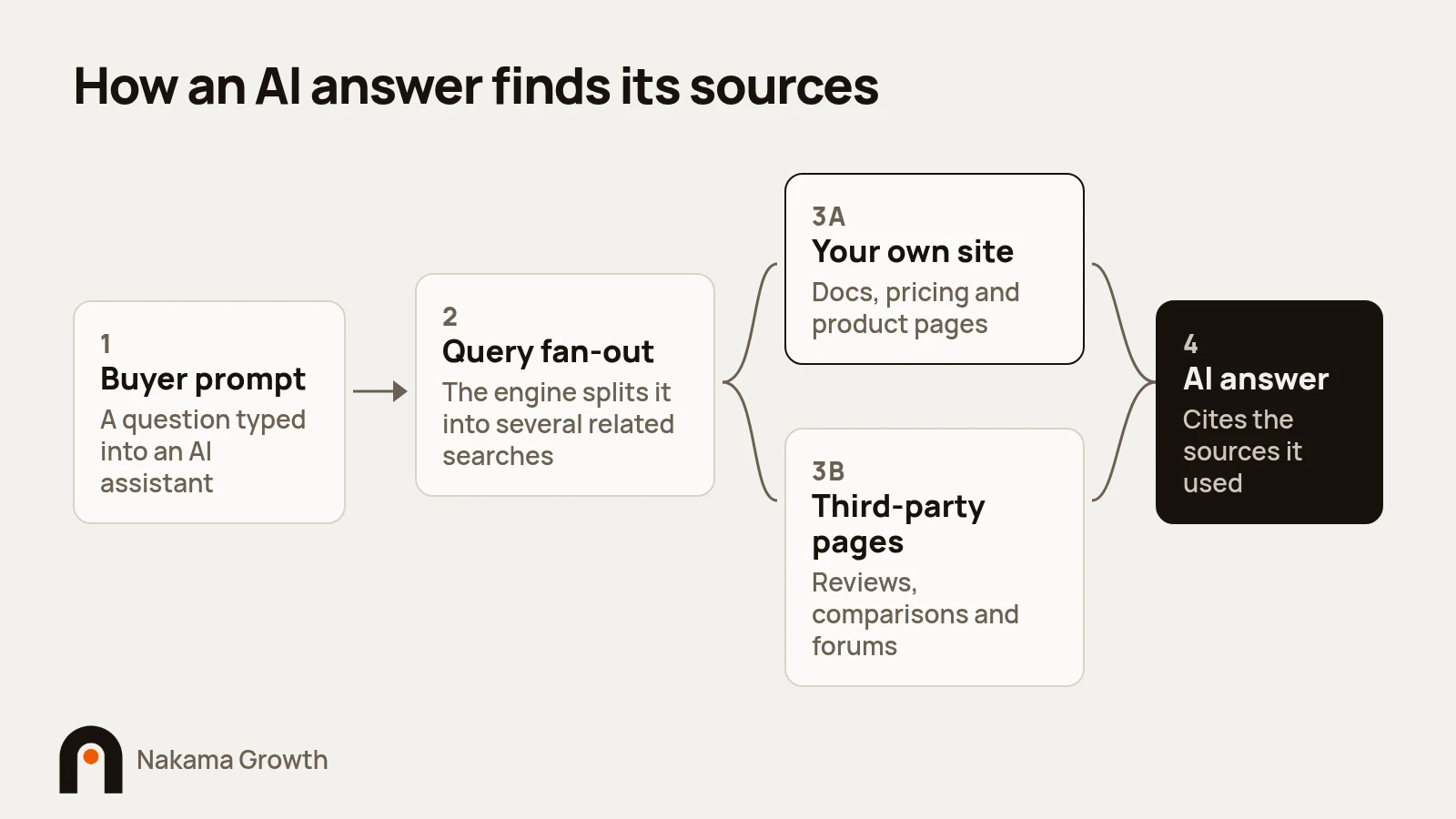
Answer engines run one or more background searches, called query fan-out, then pick sources from what those searches return. Google confirms AI Overviews and AI Mode may use fan-out. Ahrefs found 14.4% of 66.6 million free, logged-out ChatGPT responses contained fan-out queries, at about 1.6 queries each. Your page has to match those searches.
AI Overviews are now common on buying searches. Semrush, one vendor tracking 400 US desktop commercial keywords, found AI Overviews on 88% of them in August 2026, up from 45.75% in September 2025, and on every tracked software "alternatives" and "best X for Y" keyword. The study measured appearance only, with no click data.
Ranking still helps, but it is a weak proxy. Ahrefs' March 2026 study of 863,000 keyword results and 4 million cited URLs found only 37.9% of AI Overview citations also ranked in the top 10 results. In July 2025 the figure was about 76%.
The rest split almost evenly. 31.2% came from positions 11 to 100, and 31.0% came from beyond position 100.
Why do factual prompts cite your own site?
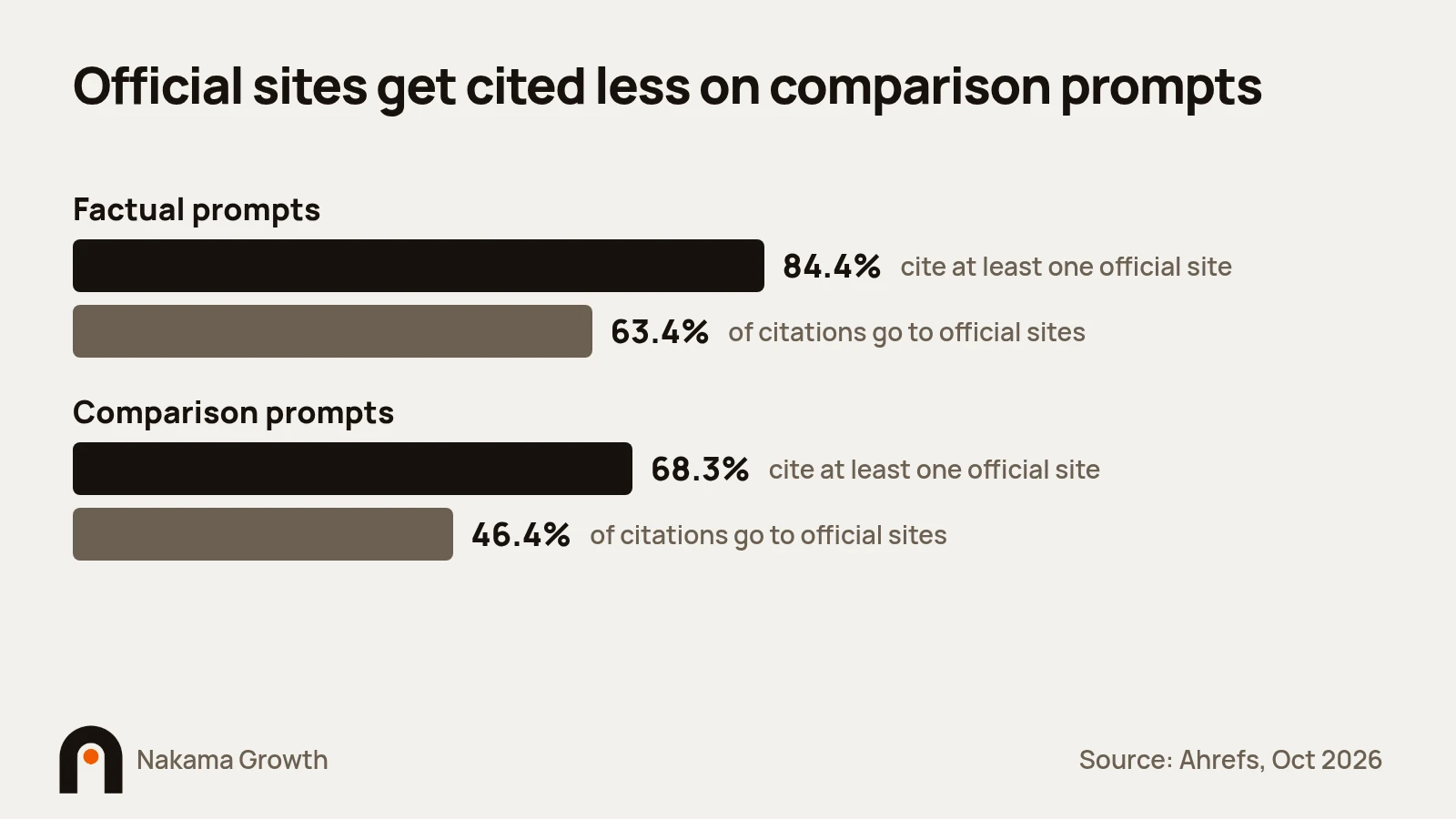
Factual prompts cite your own site because you own the facts. In Ahrefs' test of 20,000 US prompts, 84.4% of factual questions about pricing, product features or company details cited at least one official source. Official websites earned 63.4% of all citations on those factual questions. For SaaS, your pricing, features and docs pages are the source.
ChatGPT also searches brand sites directly. Of the most common site: fan-out searches Ahrefs studied, 75.9% pointed at a brand site.
The intent is shifting toward facts. Between August and September 2026, "price" rose from 6.04% to 8.88% of ChatGPT fan-out queries, and "official" rose from 10.1% to 13.1% of English fan-outs.
Why do comparison prompts lean on third-party pages?
Comparison prompts lean on third-party pages because no single brand is a neutral source for "which is better". In the same Ahrefs test, 68.3% of comparison questions cited an official source, and official sites earned only 46.4% of citations. More than half went to other sites, such as reviews, listicles and publications.
Off-site presence shows up in Google's AI features too. Ahrefs' 2025 study of 75,000 brands found brand web mentions correlated at 0.664 with AI Overview brand visibility. Backlinks correlated at 0.218.
That is a correlation study, so it shows a pattern and doesn't prove cause. It still points the same way as the ChatGPT data: being talked about across the web matters for comparative questions.
Does each engine behave the same?
No. Each engine uses its own crawler, index and model, so the same prompt can cite different sources. Google says AI Overviews and AI Mode may use different models and techniques. Search behaviour also shifts over time, and location settings change results, so test each engine separately with the same prompt set.
| Engine | How it finds sources | Crawler or control | Known caveat |
|---|---|---|---|
| Google AI Overviews | Query fan-out across related searches | Googlebot; page must be indexed and snippet-eligible | Often doesn't trigger; only 37.9% of citations overlap the top 10 |
| Google AI Mode | Query fan-out; built for comparisons and reasoning | Googlebot | May use different models from AI Overviews, so links vary |
| ChatGPT | Fan-out on some responses; frequent site: searches of brand sites | OAI-SearchBot for search; GPTBot is separate and for training | Uses in-app location, down to city, per one 2026 study |
| Perplexity | Surfaces and links websites in its search results | PerplexityBot | Source selection details not confirmed from vendor docs |
| Claude | Search indexing by Claude-SearchBot | Claude-SearchBot; blocking it may reduce visibility in search results | One report suggests search behaviour changed around 5 Oct 2026; Anthropic hasn't confirmed it |
| Gemini | Not confirmed from vendor docs | Not confirmed from vendor docs | Uses connection country for location, per one 2026 API study |
Data checked 25 Oct 2026.
ChatGPT's source mix is moving fast. Ahrefs' Brand Radar data shows Reddit citations in ChatGPT dropped 88% in six months. Wikipedia fell from 1 in 7 answers to 1 in 35, and YouTube from about 1 in 370 answers to 1 in 500.
Reddit still matters for ChatGPT research. It was the ninth most site: searched domain in the same study, which suggests ChatGPT still checks it for real user opinions.
Google AI Overviews weigh sources differently. In Ahrefs' March 2026 study, YouTube made up 5.6% of all AI Overview citations and 18.2% of the citations that came from beyond the top 100.
What does an answer engine optimization playbook for SaaS look like?
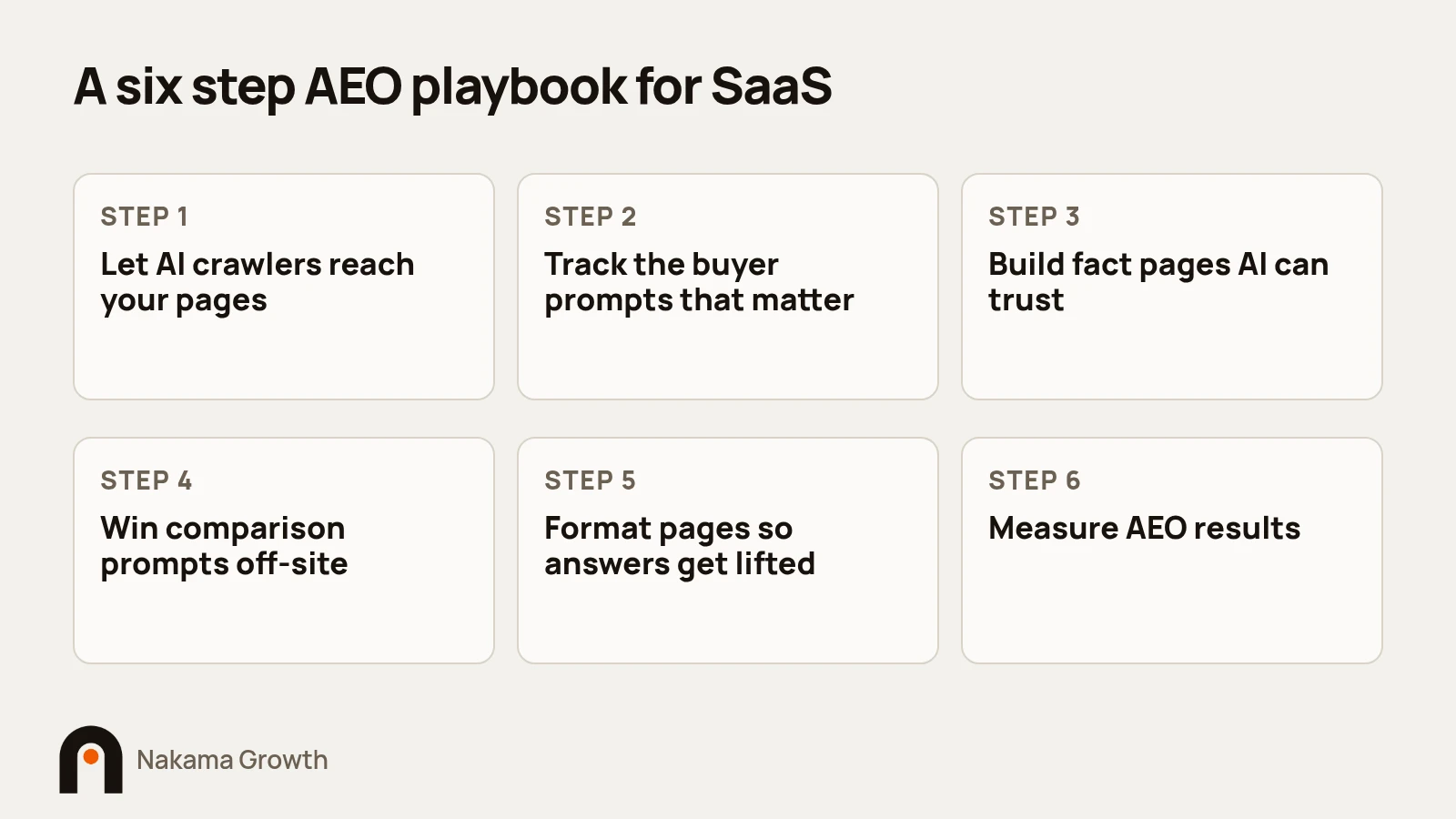
A SaaS answer engine optimization playbook has six steps. Open access for AI crawlers. Pick the buyer prompts you want to win. Publish clear fact pages. Earn third-party mentions for comparison prompts. Format pages so answers lift cleanly. Then measure citations across engines every month and adjust the plan based on what moved.
Step 1: Can AI crawlers reach your pages?
Check robots.txt, your CDN and your firewall for each AI search crawler. OpenAI says sites that opt out of OAI-SearchBot won't appear in ChatGPT search answers. Google says a page must be indexed and eligible for a snippet to appear in AI Overviews or AI Mode. Perplexity and Anthropic run PerplexityBot and Claude-SearchBot.
Training and search are separate controls at OpenAI. You can allow OAI-SearchBot and block GPTBot, and OpenAI says robots.txt changes take about 24 hours to apply to search.
Google states its AI features have no extra technical requirements beyond indexing and snippet eligibility. Spend that effort on the other engines' crawlers instead.
Step 2: Which buyer prompts should you track?
Track the prompts a buyer types before shortlisting a tool. Group them into factual prompts about your pricing, features and integrations, comparison prompts against named rivals, and category prompts such as "best tool for X". Run each group on every engine you care about and record who gets cited.
Set location on purpose. In one 2026 API test, ChatGPT used the location set in the app and Gemini used the country of the connection. App behaviour may differ, so test from the markets you sell into.
Step 3: How do you build fact pages AI trusts?
Build one clear page for each fact a buyer asks about: pricing, features, integrations, security and compliance, and changes. Put the facts in plain text with dates. Because factual prompts cite official sources 84.4% of the time in Ahrefs' test, these pages are your best shot at owning those answers.
Keep numbers visible on the page. Plan names, seat prices and limits should be readable text, since Google asks that important content be available in textual form.
If you add structured data, make it match the visible page. Google lists this as a best practice for its AI features.
Ahrefs also found ChatGPT is moving toward original sources over sites that summarize them. Your own product facts are content only you can publish.
Step 4: How do you win comparison and "best" prompts off-site?
Win comparison prompts by being present on the pages engines cite when they weigh options. That means third-party listicles, review sites, honest Reddit discussions, YouTube walkthroughs and trade publications. Official sites earned only 46.4% of citations on comparison questions in Ahrefs' test, so most of the answer is built elsewhere.
Start with the pages already cited for your category prompts. Your Step 2 tracking shows which listicles and reviews keep appearing, and those are your outreach list.
Partner publications are worth a look for ChatGPT. Ahrefs found titles with OpenAI licensing deals more than doubled their share of citations among the 200 most-cited domains, from 7.5% in March to 15.8% in July 2026.
Ahrefs' data suggests ChatGPT uses Reddit more for research than for citations, so treat honest Reddit presence as a way to shape the opinions engines read. Its ChatGPT citations fell sharply, yet ChatGPT still runs site: searches on it.
YouTube is worth the effort for Google. A short walkthrough of your product can be cited in AI Overviews even when it doesn't rank for the query.
Step 5: How do you format pages so answers get lifted?
Format each section so it can stand alone. Use a question as the heading, answer it in the first 40 to 60 words, then add detail, lists or a table. Answer engines extract passages, so a section that needs the rest of the page to make sense is harder to quote.
Add a visible "updated" date. ChatGPT fan-outs often include the year, and "2026" appeared in 22.9% of English fan-outs in September in Ahrefs' data.
Step 6: How do you measure AEO results?
Measure how often you are cited for your tracked prompts, per engine, each month. Rankings can't stand in for this, because citations and top-10 positions overlap only 37.9% of the time in Google AI Overviews. Pair prompt tracking with Search Console, which counts AI Overviews and AI Mode traffic inside the Web search type.
Google says clicks from results pages with AI Overviews are higher quality, meaning users spend more time on the site, though it hasn't published data to back that. Track conversions and engaged time alongside citation counts.
Rerun the same prompts after each change so the comparison is fair. Our GEO audit guide covers the full audit method, and our list of AI visibility tools compares trackers.
| Prompt type | Example | Who tends to get cited | SaaS action |
|---|---|---|---|
| Factual | "Tool A pricing" | Official site (84.4% cite one; 63.4% of citations) | Clear pricing, features and docs pages |
| Comparison | "Tool A vs Tool B" | Mostly other sites (official share 46.4%) | Third-party reviews and comparison coverage |
| Category | "Best tool for X" | Listicles, reviews, publications | Outreach to pages already cited |
| How-to | "How to do X" | Pages that answer the task directly | Answer-first guides and videos |
The first two rows come from Ahrefs' 20,000 prompt test. The last two rows are our working guidance from the same pattern and are not measured figures.
How do you improve brand visibility in AI answer engines off-site?
You can improve brand visibility in AI answer engines mostly off-site. Comparison and category prompts pull heavily from third-party pages, and brand web mentions correlate far more strongly with AI Overview visibility than backlinks. That lets a SaaS team grow citations through reviews, listicles, Reddit, YouTube and publications while the website stays as it is.
This is where Nakama Growth focuses. We work off-site only. We find the third-party pages engines already cite for your prompts and work to get your product represented there accurately.
On-site work still has a floor. Your crawlers need access and your fact pages need to be clear, which covers Steps 1 and 3.
Is LLM SEO different from answer engine optimization?
LLM SEO and answer engine optimization describe the same goal: getting cited in answers produced by large language models. The labels differ by community and vendor. The work is the same set of steps covered above, from crawler access and fact pages to third-party mentions and prompt tracking across each engine you sell into.
If you want the full terminology map, our AEO vs SEO vs GEO guide covers it.
How do you rank in Google AI Mode as a SaaS brand?
Google says the same SEO fundamentals apply to AI Mode, with no extra requirements or special markup. AI Mode is built for comparisons and complex questions and uses query fan-out, so SaaS brands should cover comparison topics in depth and earn mentions on the third-party pages that appear in related searches.
For tactics on the sister feature, read how to rank in Google AI Overviews. For ChatGPT SEO, see how to rank in ChatGPT.
Should you do AEO in-house or hire help?
Most SaaS teams can handle crawler access, fact pages and formatting in-house, since they own the product facts. The off-site work takes more time: tracking prompts across engines, finding cited pages and earning coverage there. Teams short on hours often bring in help for that part and keep fact pages in-house.
If you are comparing providers, our guide to the best AEO agencies lists options with their strengths and weaknesses.
If you want to see where your SaaS brand stands today, Book a GEO audit call with Nakama Growth.
FAQ
What is answer engine optimization?
Answer engine optimization is the work of getting a brand named and cited when people ask AI assistants and AI search features a question. For SaaS, it means owning factual prompts about your product and earning a place in comparison and category prompts.
How long does answer engine optimization take to show results?
There is no reliable public benchmark for timing. Crawler changes can apply quickly; OpenAI says robots.txt updates take about 24 hours to reach ChatGPT search. Content and off-site changes depend on recrawls and on how often engines search, so track the same prompts monthly.
Do I need llms.txt or special schema for AEO?
Google says its AI features need no extra files or special markup beyond normal indexing. Other engines rely on their own crawlers, so crawler access and clear fact pages matter more than llms.txt. Any structured data you add should match the visible page.
Does ranking first on Google mean AI will cite me?
No guarantee. In Ahrefs' March 2026 data, fewer than two in five AI Overview citations came from top 10 pages, and nearly a third came from beyond position 100. Track your citations per engine to see where your brand actually stands.
Which pages should a SaaS company fix first for AEO?
Start with the pages that answer factual prompts: pricing, features and docs. Factual questions cite official sites most often, so make prices, plans and capabilities clear in plain text. Then move to the third-party pages engines cite for comparison prompts.
How do I track whether ChatGPT mentions my SaaS?
Build a fixed list of buyer prompts, run them in ChatGPT on a set schedule from the locations you sell into, and log which brands and URLs get cited. Our AI visibility tools guide compares trackers that automate this. Keep the prompt list fixed between runs.
Is AEO worth it for early-stage SaaS?
Early-stage teams can start cheaply. Opening crawler access and publishing clear pricing and feature pages cost little, and factual prompts favour official sources. Off-site work can scale later as your category prompts become clear. Start by tracking ten to twenty buyer prompts so you can see which ones move first.
About the author