AEO vs SEO vs GEO: the difference and what to do first
Published 16 Oct 2026. Last updated 16 Oct 2026.
By Snehil Srivastava, CEO & Creative Director, Nakama Growth
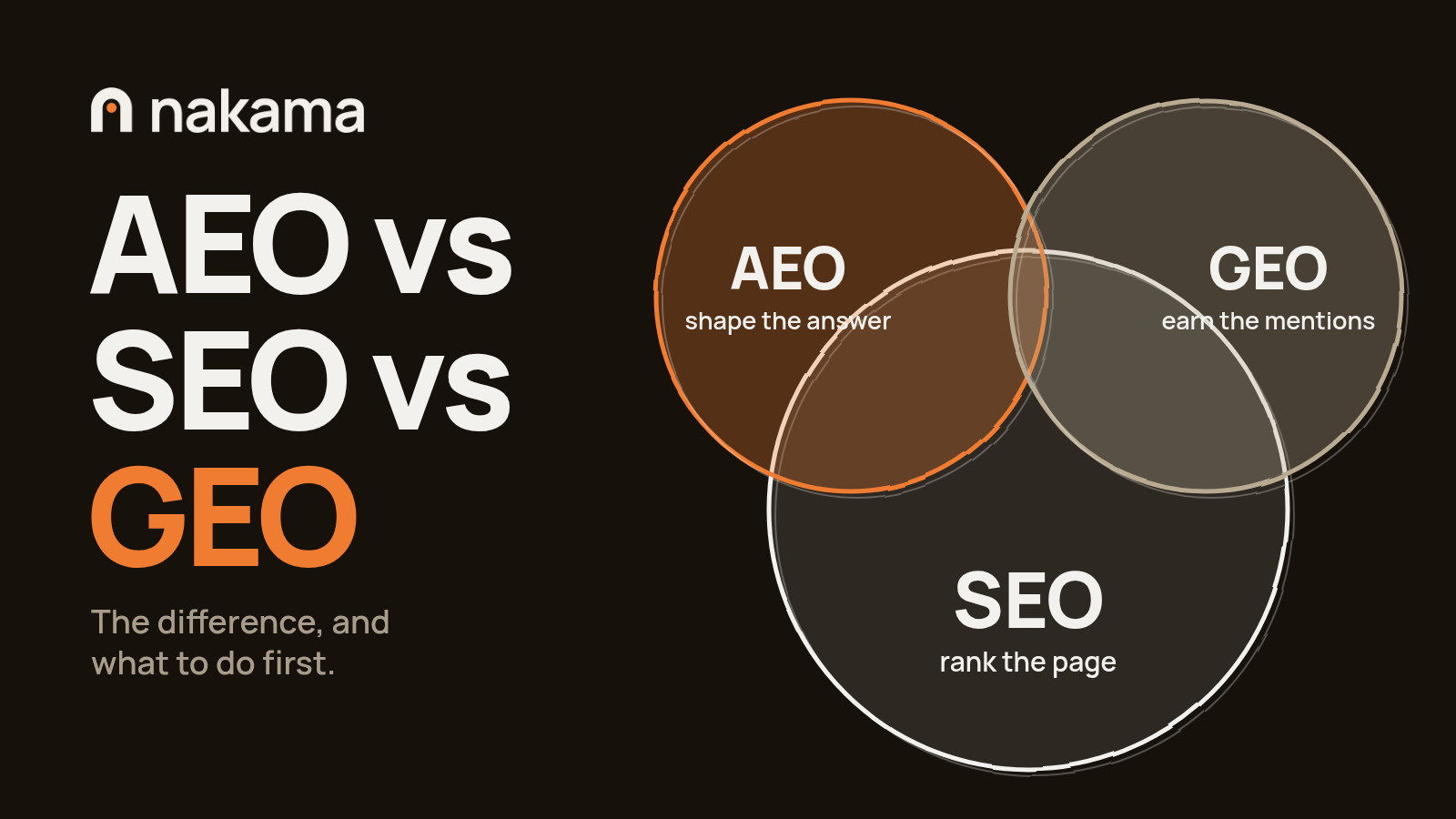
AEO vs SEO: the difference is that SEO ranks pages in search results, while AEO (answer engine optimization) makes a passage the answer a search feature or assistant shows. GEO vs SEO: the difference is that GEO (generative engine optimization) aims to get your brand cited or named inside AI-generated answers. Google says work on both is still SEO.
The short verdict
Google's guide to optimizing for generative AI features (last updated 10 Jul 2026) says that from Google Search's perspective, optimizing for generative AI search "is optimizing for the search experience, and thus still SEO." So most AEO and GEO work is SEO work you may already be doing.
Its page on AI features and your website (last updated 10 Dec 2025) adds that there are "no additional requirements to appear in AI Overviews or AI Mode." A page has to be indexed and eligible to show with a snippet, the same bar as normal search. Google's newer guide adds that the site must be included in Search generative AI features in Search Console.
So the overlap is large. Four things still differ:
- The win is a mention or citation inside an answer, often with no click.
- Off-site sources tend to matter more. AI answers pull from many pages, so what other sites, videos and forums say about you can count.
- Each engine behaves differently. ChatGPT and Perplexity run their own crawlers (OpenAI, Perplexity). Google's AI features page says AI Overviews and AI Mode "may use different models and techniques, so the set of responses and links they show will vary."
- Measurement needs repeat sampling. The same prompt can return different sources minutes apart, so one check proves little.
AEO vs SEO vs GEO at a glance
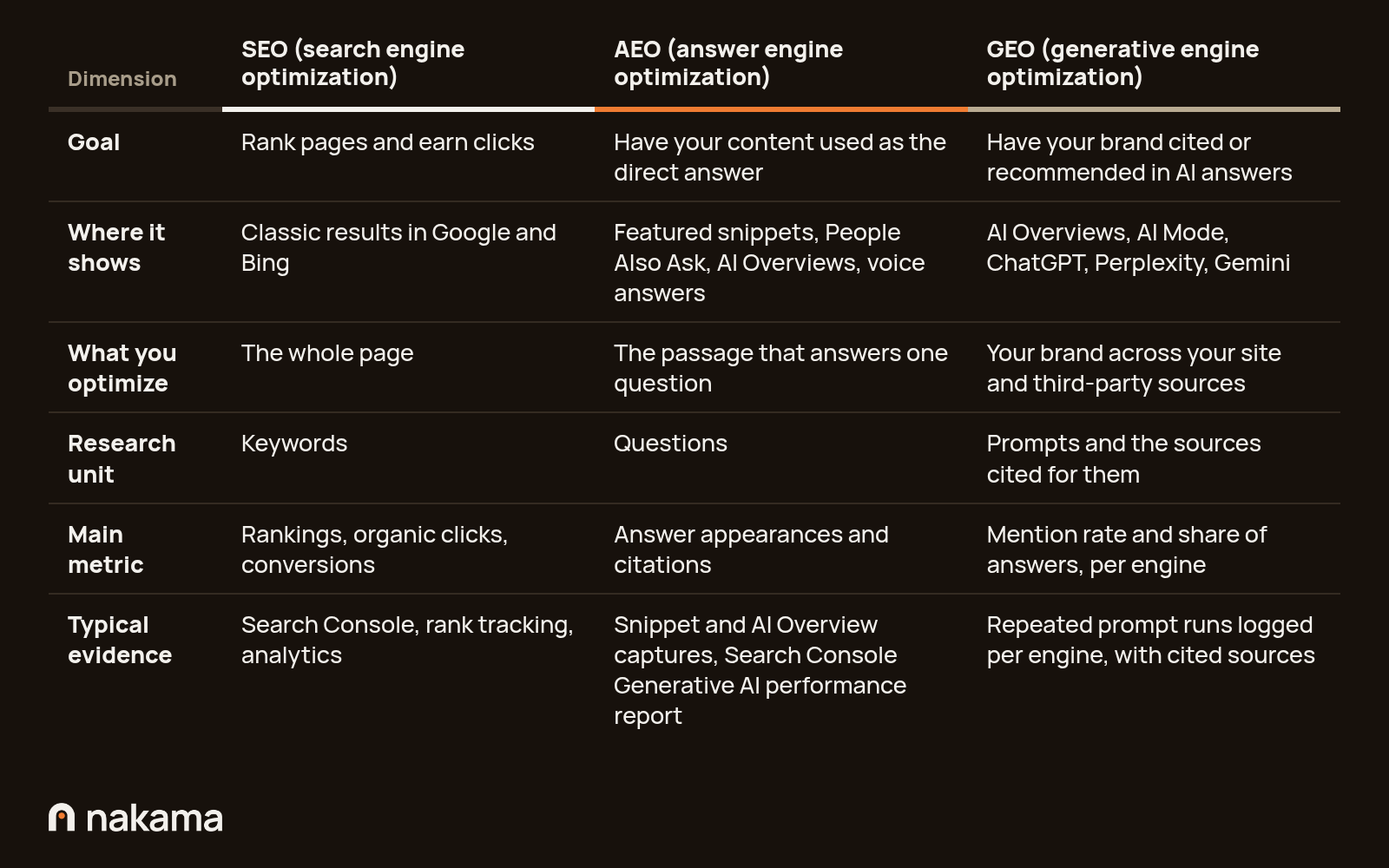
SEO ranks pages, AEO makes one passage the direct answer, and GEO gets your brand named in AI answers. The table compares them on goal, where each shows up, what you optimize, how you research, the main metric and the evidence you collect. SEO is the base under the other two, so the rows overlap.
| Dimension | SEO (search engine optimization) | AEO (answer engine optimization) | GEO (generative engine optimization) |
|---|---|---|---|
| Goal | Rank pages and earn clicks | Have your content used as the direct answer | Have your brand cited or recommended in AI answers |
| Where it shows | Classic results in Google and Bing | Featured snippets, People Also Ask, AI Overviews, voice answers | AI Overviews, AI Mode, ChatGPT, Perplexity, Gemini |
| What you optimize | The whole page | The passage that answers one question | Your brand across your site and third-party sources |
| Research unit | Keywords | Questions | Prompts and the sources cited for them |
| Main metric | Rankings, organic clicks, conversions | Answer appearances and citations | Mention rate and share of answers, per engine |
| Typical evidence | Search Console, rank tracking, analytics | Snippet and AI Overview captures, Search Console Generative AI performance report | Repeated prompt runs logged per engine, with cited sources |
AEO vs SEO: what is the difference?
AEO vs SEO comes down to the unit of success. SEO tries to rank a page so people click it. AEO tries to make one passage the answer a search feature or assistant shows, even if nobody clicks. Both need a crawlable, indexed, well-written page. AEO adds answer-first structure and question-led headings on top of that.
In practice, you take a page that already ranks and put the answer to its main question in the first lines under the heading, in plain words that still make sense when quoted alone.
GEO vs SEO: what changes and what does not
GEO vs SEO is a question of scope. SEO works mostly on your own site and its links. GEO aims to get your brand named inside AI-generated answers, which draw on many sources at once. Your own pages still matter. What third parties say about you, and how each AI engine retrieves sources, can matter more.
The term comes from a 2023 research paper by Aggarwal and colleagues, later accepted at KDD 2024. Google's guide now describes AEO and GEO as terms used for work focused on visibility in AI search.
Two things change most with GEO:
- Sources outside your site. AI answers often name brands from reviews, forums, videos and comparison articles. Google's guide warns that seeking inauthentic mentions "isn't as helpful as it might seem," so the work is earning real coverage.
- Unstable results. A St. Gallen preprint from April 2026 tracked four AI search engines (ChatGPT, Gemini, Google AI Mode and Perplexity) on a small set of German-language prompts run from servers in Switzerland. Across four topic areas, the average overlap (Jaccard similarity) of cited sources between consecutive days was 34 to 42%. Repeating the same prompt within 24 hours gave an average source overlap of 32 to 43% by topic area.
What does not change: crawlable pages, useful content, a clear site structure and real authority.
SEO vs AEO: which should you do first?
SEO vs AEO is a question of order: SEO first, then AEO on the same pages. Google requires a page to be indexed and snippet-eligible before it can appear in AI Overviews or AI Mode, and a page that is not indexed cannot be quoted. Once a page ranks or is close to ranking, add answer-first passages and question headings.
Your best existing pages carry the AEO work. Make each one answer its main question faster. The full order is in what to do first.
AEO vs GEO: are they the same thing?
AEO and GEO are mostly the same thing, and AEO vs GEO is largely a naming fight with no agreed definition. This guide uses one split: AEO is the answer work on your own pages, and GEO is the wider job that adds third-party sources and measurement. GEO vs AEO is the same question reversed, so the split holds.
SEO vs GEO vs AEO in one line
SEO vs GEO vs AEO, or AEO vs GEO vs SEO, in one line: SEO earns the ranking, AEO shapes the answer on your page, and GEO earns the mentions elsewhere that AI engines use when they build an answer.
Who defines what, and why the definitions clash
Definitions of AEO and GEO differ by source, and some of those sources, such as Yext and Jasper, sell products built on them. Google says the work is still SEO, while Yext, Adobe and Jasper each describe the terms in their own words. Here is how each puts it, checked on 16 Oct 2026:
- Yext (22 Sep 2025) frames AEO around answers in AI Overviews and voice assistants, and GEO around being cited by generative AI systems.
- Adobe describes AEO as content extracted into featured snippets, People Also Ask boxes and AI Overviews, and GEO as content that large language models reference and cite.
- Jasper (updated 8 Oct 2026) says AEO structures content to answer user questions directly, while GEO earns visibility and citations in AI-generated responses.
- Google (last updated 10 Jul 2026) describes AEO and GEO as terms for work on visibility in AI search, and says that from Google Search's perspective optimizing for generative AI search is "still SEO."
- Forrester analyst Nikhil Lai (24 Nov 2025) wrote that AEO is "significantly, but not fundamentally, different from SEO."
Yext names voice assistants in its AEO definition and Adobe names People Also Ask boxes, though both name AI Overviews. A definition alone will not tell you what to do.
What Google showed for AEO vs GEO vs SEO on 16 Oct 2026
We checked the live results for "aeo vs geo vs seo" on 16 Oct 2026, in a logged-out Google session set to US English. This was one run of each feature, so treat it as a small snapshot. One run is not a trend.
- The AI Overview answered with definitions and a comparison table. It cited nine sources, read from the source labels: Medium (Shanika Wickramasinghe), Digital Marketing Institute, Jasper, Searchable, YouTube (SMA Marketing), Magneto IT Solutions, Refinery89, Writer and Adobe for Business.
- AI Mode opened with a table and showed no citations on two loads.
- Reddit ranked second in the organic results but was not cited in the AI Overview on that run.
- AI Mode used tables often. Across 10 queries on AI search topics that we ran that day, AI Mode answered 7 with a table. Only 2 of the 10 were phrased as "vs" comparisons, and the AI Overview used a table for 1 of the 10.
Two things stand out in this snapshot. For this comparison query AI Mode opened with a table, so a clean table may help a page match the answer format. And a Medium post and a YouTube video were among the cited sources, which fits the off-site point above. This was one run in one session.
AEO vs SEO vs GEO: what to do first, in order
Here is the order we would follow for most sites: fix access, improve the pages that already rank, build mentions elsewhere, then measure. Each step depends on the one before it, because a page that Google or ChatGPT cannot reach is much less likely to be quoted or cited.
- Fix indexing and crawler access. Check that your key pages are indexed and can show a snippet. Then check robots.txt and your CDN rules for each engine.
- ChatGPT. OpenAI's crawler docs list four agents, and three matter here. Each setting is independent.
- OAI-SearchBot surfaces sites in ChatGPT search. Sites that opt out of it will not be shown in ChatGPT search answers, though they can still appear as navigational links.
- GPTBot collects content that may be used for model training, so blocking GPTBot does not remove you from ChatGPT search.
- ChatGPT-User fetches pages when a user asks, and robots.txt rules may not apply to it.
- The fourth agent, OAI-AdsBot, only visits pages submitted as ads on ChatGPT.
- Google. Google-Extended, which manages whether crawled content is used to train Gemini models and for grounding in Gemini Apps and Vertex AI, "does not impact a site's inclusion in Google Search." For AI features in Search, Google points to robots.txt rules for Googlebot and snippet controls such as nosnippet.
- Search Console. Google's guide says a site must be included in Search generative AI features to be eligible. In Search Console this is the Search generative AI control, under Settings.
- Default setting. Sites are included by default (a property with a parent property inherits the parent's setting), and Google rolled the control out to all sites on 31 Aug 2026, so check that nobody has switched it off.
- ChatGPT. OpenAI's crawler docs list four agents, and three matter here. Each setting is independent.
- Add answer-first passages to pages that already rank. Start with pages on page one or two for question queries. As a working target of our own, put a direct 40 to 60 word answer under each main heading. Google's guide does not ask for a set length. Use headings that match how people phrase the question. Add a comparison table where readers are comparing options.
- Build entity and off-site presence. Keep your brand name, category and description consistent everywhere. Earn real mentions in third-party articles, reviews, YouTube videos and community threads such as Reddit, with honest participation.
-
Measure with repeated runs per prompt, per engine. Pick a fixed set of prompts. Run each one several times per engine and log the brands and sources named. Report each engine separately.
The St. Gallen preprint recommends at least 7 runs per prompt per day for brand visibility and at least 8 when source-level coverage matters. The figures come from the study's repeated-run dataset in Switzerland (eight prompts in each of four topic areas, four engines, up to 10 runs each). Seven runs can spot large differences between brands but are too few to rank similar ones.
In Google, also check the Generative AI performance report in Search Console.
For what a useful visibility report should contain, see what a useful visibility report actually shows.
When plain SEO is the answer
- Your important pages are not indexed, or they cannot show a snippet. No AI feature in Google can use them yet.
- You get little organic traffic for your core terms. Google's AI features draw on its core ranking systems, so ranking well comes first.
- Your queries rarely trigger an AI Overview. Google says AI Overviews show only when they add something to classic results.
- Someone is selling you llms.txt files, special schema or "chunking" as the fix. Google's guide lists llms.txt files and other special markup, and "chunking", as things you can ignore for Google Search. It says structured data is not required for AI search but is still worth keeping for SEO.
In these cases, spend the budget on technical SEO, better pages and real authority first.
What is the relationship between SEO and AEO?
SEO is the foundation and AEO is a layer on top of it. Google says its AI features are rooted in its core ranking and quality systems, and a page must be indexed and snippet-eligible to appear in them. AEO then shapes how a ranking page presents its answers, so search features and assistants can lift a clear passage.
Is SEO dead?
SEO is not dead. Google's guide (last updated 10 Jul 2026) answers "Is SEO still relevant for generative AI search?" with "In short, yes!" It says SEO best practices still apply because its AI features rely on its core search systems. Where visibility shows up is changing. The work that earns it is still SEO work.
AEO, SEO and GEO FAQ
Will AEO replace SEO?
AEO will not replace SEO, on current evidence. AEO depends on SEO. Google builds AI answers from its search index, and ChatGPT search answers do not show sites that opt out of OAI-SearchBot as sources, though those sites can still appear as navigational links. Without crawlable, indexed, useful pages there is nothing to quote.
Is AEO a part of GEO?
AEO and GEO overlap. Some sources treat GEO as the wider term and AEO as the on-page answer work inside it, and that is the split this guide uses. Others use the two names for the same job. What matters is whether the work covers your own pages, third-party sources and measurement.
Is AI SEO called GEO?
AI SEO is often called GEO. AI SEO, GEO, AEO and LLMO are all used for the work of earning visibility in AI answers, and usage varies by vendor. Google calls it SEO. Pick one term for your team, define what it covers, and do not pay twice for the same work under two names.
How do I show up in Google AI Overviews?
Get the page indexed and eligible for a snippet, then make it the best answer for the question. Google lists no extra technical requirements for AI Overviews and no special schema. Answer the question near the top, support it with original detail, keep the page crawlable, and check the Generative AI performance report in Search Console.
How do I optimize for ChatGPT?
Allow OAI-SearchBot in robots.txt and at your CDN, because OpenAI says sites that opt out of it will not be shown in ChatGPT search answers, though they can still appear as navigational links. Then publish clear, answer-first pages, earn mentions on third-party sites, and track a fixed set of prompts over repeated runs. Expect answers to vary between runs.
Do I need both SEO and AEO or GEO?
You need SEO either way. AEO and GEO are worth adding once your key pages are indexed and ranking, and when your buyers use AI tools to research. For most teams that means one plan with SEO at the base and AEO and GEO work added on top.
Do llms.txt or schema markup get you cited?
Google's guide lists llms.txt files among the things you can ignore for Google Search, and says no special schema is needed for its AI features, so be wary of anyone selling either as a fix. Structured data can still help with rich results, so keep it accurate and matched to visible text.
Does blocking GPTBot remove my site from ChatGPT search?
Blocking GPTBot does not remove your site from ChatGPT search. OpenAI's docs say GPTBot is for model training and OAI-SearchBot is for ChatGPT search. Each setting is independent, so you can block GPTBot to signal that your content should not be used for training while still allowing OAI-SearchBot, and your pages can still be shown in ChatGPT search answers.
What should a small team do first?
Fix indexing and crawler access, then add answer-first passages to pages that already rank. Measure with repeated runs per engine before you spend on tools or agencies. Most of this early work is SEO work, so a small team can start with the pages and skills it already has.
The one thing to remember
Treat AEO and GEO as SEO with two extra jobs: earning mentions on sources you do not own, and measuring answers that change from run to run. For help with both, see how Nakama works on AEO and GEO. To compare providers, see our best AEO agencies guide (ten firms) and best GEO agencies guide (nine firms).
About the author